
When school ERP is not available, Excel is not a bad tool. WhatsApp is not a bad communication platform. Paper is not useless. The problem begins when a school asks each of them to become something it was not designed to be: the permanent operating system for admissions, finance, academics, attendance, staff records, parent communication and management reporting.
A school can run this way for years because the people inside the system learn how to compensate. The bursar knows which spreadsheet is current. The administrator remembers which WhatsApp group has the correct list. A teacher keeps a personal copy of scores. The owner calls trusted staff when a number looks wrong. Work gets done, but the process depends on memory and heroic effort.
The hidden cost appears as the institution grows, staff change, parents expect faster service or leadership needs reliable information quickly.
Fragmentation usually looks cheaper than it is
A spreadsheet may cost nothing beyond a normal office subscription. WhatsApp is already on everyone’s phone. Paper registers are familiar. So the school compares those tools with the subscription price of an ERP and assumes the disconnected method is cheaper.
The comparison is incomplete because it ignores labour and error. If three staff members spend several hours every week reconciling records, that time has a cost. If parents call repeatedly because balances are unclear, that has a cost. If results are delayed because files must be merged manually, that has a cost. If a former employee leaves with the only accurate copy of a workbook, the risk has a cost.
Good technology investment decisions compare total operating cost, not licence price alone.
Duplicate entry is one of the largest invisible expenses
In a fragmented school, the same child may be typed into an admission sheet, student register, fee ledger, class list, attendance register, result template and parent contact database. Every duplicate entry is an opportunity for spelling differences, wrong class assignment, stale phone numbers or conflicting IDs.
The workload compounds when something changes. A learner who moves class may need to be updated in several places. A parent changes phone number, but only one file is corrected. A new session begins and staff copy last term’s spreadsheets, carrying old errors forward.
A connected ERP uses a canonical student record and allows other workflows to refer to it. This is one of the least glamorous features of a management system and one of the most valuable.
WhatsApp is excellent for conversation but weak as a database
Schools understandably rely on WhatsApp because parents and staff already use it. It is useful for announcements, quick questions and community communication. Problems arise when chats become the official archive for payments, approvals, attendance exceptions, documents and decisions.
Messages are difficult to classify, permission boundaries are weak, personal phone numbers become part of official operations, and historical information can be hard to retrieve. A screenshot may prove that someone sent something, but it is not the same as a structured transaction record tied to a student or invoice.
The better design is to use messaging as a communication channel while keeping authoritative records in the system designed to manage them.
Spreadsheets become fragile when many people need the same truth
Excel is powerful for analysis and one-off calculations. It becomes fragile when several departments rely on different versions of the same operational data. “Final.xlsx”, “Final-new.xlsx” and “Final-corrected-2.xlsx” are not merely untidy file names; they reveal uncertainty about which version is authoritative.
Cloud spreadsheets improve collaboration but do not automatically create a school information architecture. Permissions can still be broad, relationships between records remain manual, and workflow rules depend on users doing the right thing in the right order.
An ERP does not eliminate spreadsheets. It changes their role. Excel becomes a useful export or analysis tool rather than the place where the institution’s identity, transactions and history permanently live.
Paper creates physical control but limited visibility
Paper registers can feel secure because they are tangible. A visitor can see the attendance book; a receipt booklet has serial numbers; a student file sits in a cabinet. Yet paper creates its own risks: damage, loss, unauthorised access, slow retrieval and difficulty producing aggregate reports.
A paper attendance register can show who was present in one class, but management cannot instantly compare attendance across the school. A fee ledger records payments, but leadership may not know today’s outstanding balance without manual calculation. A student file contains history, but searching hundreds of folders is slow.
Digitisation creates value when information can be safely reused for decisions, not merely when paper is scanned.
Staff turnover exposes the weaknesses of informal systems
A fragmented process often works because particular employees know how to make it work. The bursar remembers the codes. The admin officer knows which folders matter. The examination officer has a personal template. This creates key-person risk.
When such a person resigns, goes on leave or becomes unavailable, the school may discover that the process was never institutionalised. New staff inherit files without context. Errors rise. Management spends time reconstructing how things were done.
A well-configured ERP captures more of the workflow in the system itself: roles, records, statuses, histories and standard processes. People remain essential, but the institution becomes less dependent on undocumented memory.
Connected data changes the quality of management meetings
In a fragmented school, management meetings often begin with data collection. How many students are active? How much has been collected? Which teachers have completed scores? How many admissions are pending? Staff leave the meeting to find answers, or present numbers that later need correction.
A connected system allows the meeting to begin further along the decision chain. If the figures are available and reasonably current, leadership can focus on causes, priorities and action. That is a major productivity gain even if it is difficult to see on a software feature list.
The objective is not “more dashboards”. It is shorter distance between operational reality and leadership attention.
When is it time to move to an ERP?
There is no magical student number at which every school must switch. The better trigger is complexity. If multiple departments maintain overlapping records, if reporting requires manual consolidation, if parent enquiries routinely depend on finding one staff member, or if owners cannot get reliable current information quickly, fragmentation is already expensive.
Growth increases the pressure. More students create more invoices, results, attendance records and parent interactions. A second campus multiplies coordination challenges. New compliance expectations increase the value of audit trails and controlled access.
Move before the system becomes painful enough to force a rushed implementation. The best time to build operational infrastructure is while leadership still has enough capacity to manage the change deliberately.
A practical migration path with EduIntels
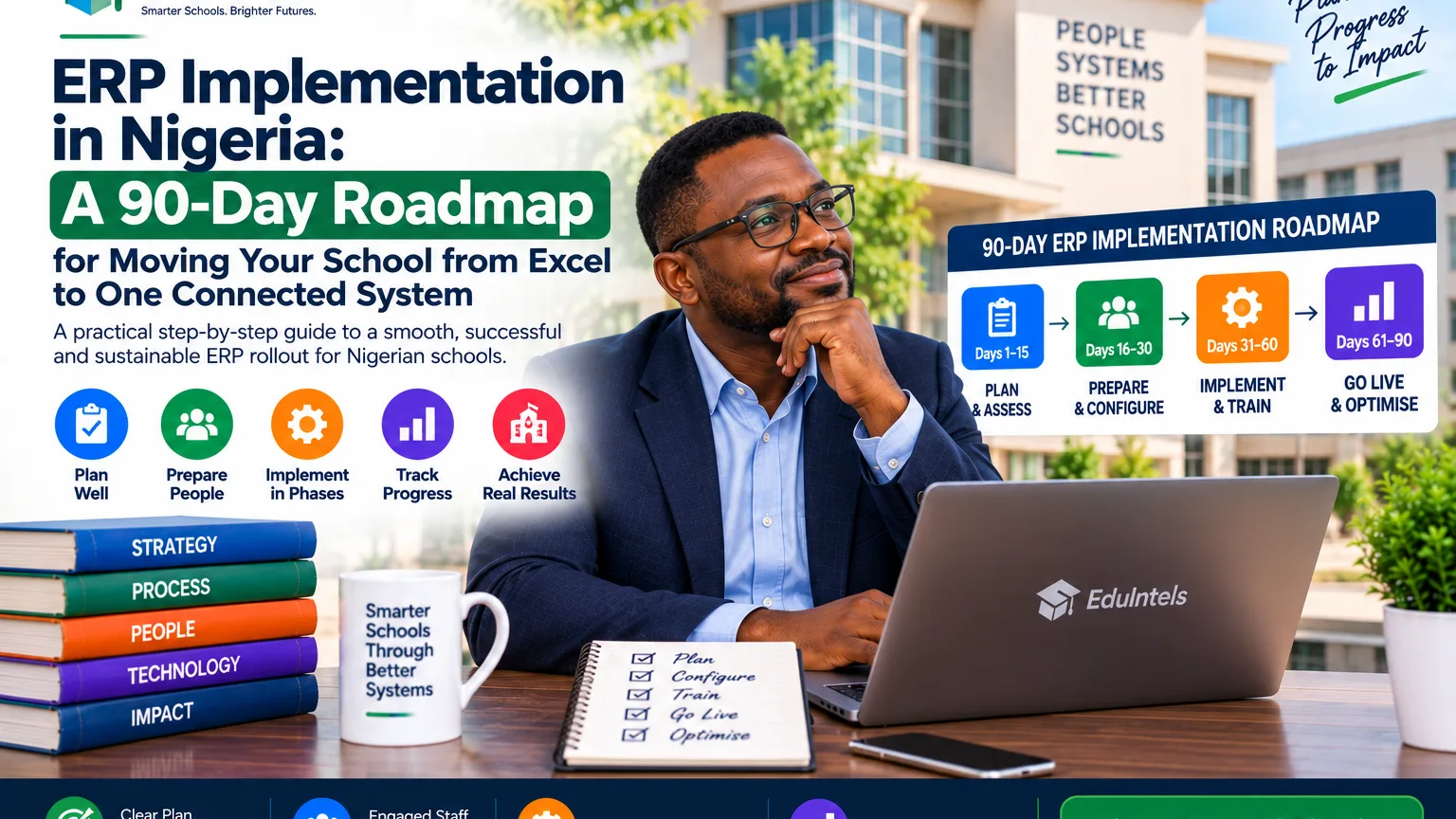
A school does not need to abandon every familiar tool on the first day. A sensible migration begins with clean identities and core records: schools or campuses, users, staff, students, classes, sessions and roles. Finance and other high-value workflows can then be configured, followed by academics, communication and deeper analytics.
EduIntels is structured as a connected operating platform, so the same institutional records can support multiple modules and user portals. That creates the possibility of gradually retiring duplicate spreadsheets while preserving exports for analysis where they remain useful.
The decision to subscribe should be based on the cost of your current fragmentation. Count staff hours, repeated data entry, reconciliation delays, parent complaints, reporting time and key-person dependency. Then compare those costs with the plan that fits your school.
Calculate a fragmentation score for your school
Give one point every time the same information is stored in another unofficial place. If student names live in admissions, finance, exam spreadsheets and WhatsApp contact lists, that is four locations. Repeat the exercise for parent contacts, fee balances, class lists, attendance and results. A high score means the school is spending energy keeping copies aligned.
Then count the handoffs required to complete a common task. How many people touch a payment before the parent receives a receipt? How many files are exchanged before a report card is published? How many messages are required before management sees the final figure? These counts create a practical baseline before migration.
Review the score three months after implementing a connected platform. The goal is not zero spreadsheets or zero messages. The goal is fewer authoritative copies, fewer manual handoffs and clearer ownership of each record.
What a connected school operating model should feel like
When the new system is working, staff should notice less chasing. Admissions should not ask finance to recreate a learner. Finance should not need a separate class list. Teachers should not send result files to three different people. Parents should not need to call the office simply to confirm a recognised payment or published result.
Management should also feel the difference. Reports should require less preparation, and explanations should begin from shared data. When an error occurs, staff should be able to trace and correct it without rebuilding the entire record from scattered evidence.
This is the real benchmark for an ERP. The institution becomes easier to coordinate. If the software simply adds another screen while old spreadsheets, paper books and chat-based approvals continue unchanged, the school has digitised tools but not transformed the operating model.
Audit how information moves through your school today
Choose one student and trace their information from admission to the current term. Where is the name stored? Where is the parent phone number stored? Which file contains the fee balance? Where does attendance live? Where are results recorded? Who has copies? Which version is considered final? This simple exercise often reveals more fragmentation than leadership expects.
Repeat the exercise for a staff member and a payment. Draw the handoffs between people and tools. Every manual copy, export, screenshot and re-entry point is a potential delay or error. Mark the places where only one employee knows what to do.
This process map gives you a migration priority. Do not digitise randomly. Start with the data and workflows that move through the greatest number of hands or create the most downstream consequences when wrong.
Understand the risk of unofficial shadow systems
Even after a school buys software, staff may maintain private spreadsheets “just in case”. Sometimes this is reasonable during transition, but if shadow systems become permanent, the school pays twice while still lacking one source of truth. The official platform says one thing and the personal workbook says another.
Leadership should identify why staff create these parallel records. Perhaps the system is missing a report, the workflow is too slow, permissions are wrong or employees do not trust the data. Fix the cause instead of simply banning spreadsheets.
The long-term rule should be clear: operational truth lives in the approved system, while spreadsheets are used for authorised analysis, temporary imports or exports. This protects continuity when staff leave and makes reporting more reliable.
Protect institutional memory during migration
Moving away from paper and scattered files should not mean losing history. Decide which legacy records must remain available for legal, financial, academic or service reasons. Clean and map those records before import. Not every old file needs to become live transactional data, but important history should remain retrievable.
Create a migration log: what was imported, what was archived, what was excluded and why. Validate a sample of student balances, results and parent relationships after import. When errors are found, correct the underlying rule rather than patching only one record.
A disciplined migration builds confidence. Staff are more willing to abandon old systems when they can see that critical history has been preserved and verified.
Set a date when the old workflow stops
Transitions fail when the school never decides which process is official. For a defined period, dual running may be sensible. After validation, however, set a cutover date for each workflow. From that date, payments, attendance, scores or whichever process is moving must be entered through the new system.
Provide support during the first days and create a quick escalation route for genuine problems. Staff should not be punished for reporting a system issue, but convenience should not become a reason to return to the old method.
Once the new workflow stabilises, remove unnecessary duplicate templates and restrict uncontrolled access to obsolete files. The objective is not to erase history; it is to prevent yesterday’s process from quietly becoming tomorrow’s default again.
Decision point for school owners
Excel, WhatsApp and paper will continue to have useful roles in schools. The mistake is allowing them to become the only architecture holding the institution together. A modern school needs conversations, documents and analysis, but it also needs a controlled source of truth.
If your team spends more time moving information between tools than acting on it, you are ready to evaluate a connected ERP. Book an EduIntels demonstration around your current workflows and ask one question repeatedly: “Which duplicate step disappears if we move this process into the platform?”
|
Next step: Book an EduIntels demonstration and ask the team to model your school’s current workflow before you choose a plan. |
Source Notes
· EduIntels connected-platform architecture and current website content, September 2026
· General records-management and role-based-access principles
· Nigeria Data Protection Act 2023 for personal-data handling context