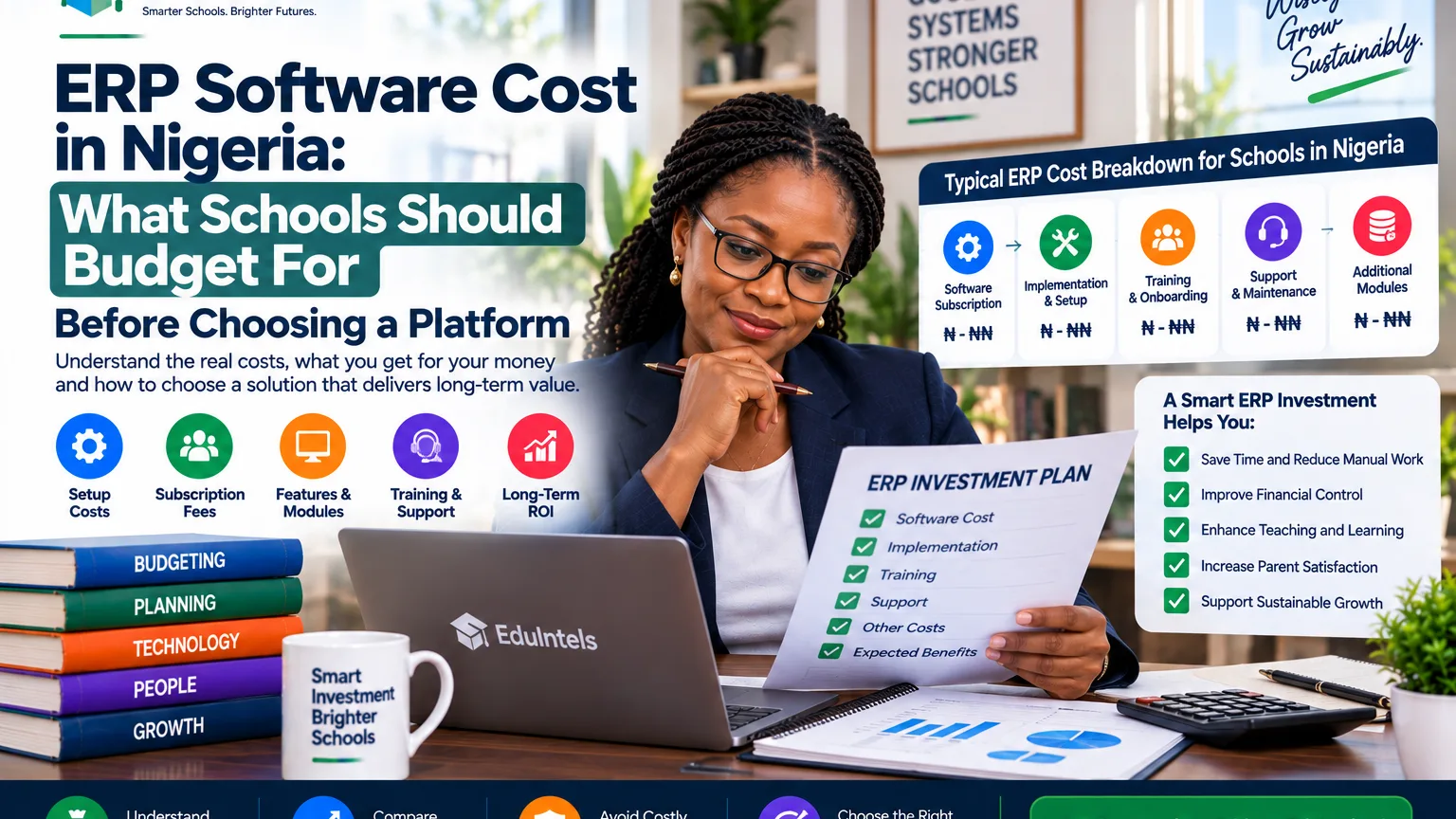
When school owners ask about ERP software cost in Nigeria, the natural question is, “How much is the subscription?” That number matters, but it is only one part of the buying decision. A low subscription can become expensive if the school pays separately for setup, migration, support, messaging, integrations and essential modules. A higher subscription can also be wasteful if the institution buys capabilities it is not ready to use.
The right comparison is total cost of ownership. That means understanding what the school will pay to acquire, configure, adopt and operate the system, then comparing that cost with the labour, errors, delays and duplicated tools the ERP is expected to reduce.
For a school, good ERP budgeting should answer two questions: “What will this platform cost us?” and “What is our current operating friction already costing us?”
Start with the pricing model, not only the price
ERP providers can charge by student population, number of users, modules, branches, transaction volume, implementation complexity or a combination of these factors. Some offer monthly and annual subscriptions. Others use custom enterprise pricing for larger institutions.
Before comparing figures, make each provider explain the unit behind the price. A monthly fee for one campus and two hundred students is not directly comparable with a quote covering several campuses, broader modules and migration support.
Also ask how pricing changes when the school grows. A plan that is affordable today should not create an unexpected cost jump when enrolment reaches the next threshold.
Subscription or licence fees are only the visible layer
The recurring platform fee normally covers the right to use the software and some level of service. Check exactly which modules, user groups, reports, storage, branches and support are included. If the product is modular, identify what is part of your starting package and what would require an upgrade later.
Do not pay for modules simply because they sound impressive. The correct package is the one that covers current priority workflows and gives the school a sensible expansion path.
Ask for the pricing structure in writing. Verbal explanations are easy to remember differently after implementation begins.
Setup and configuration have real value when they reduce implementation risk
A school ERP needs to reflect the institution’s structure: sessions, terms, classes, subjects, fee plans, roles, branches and operating rules. Some providers include configuration in the subscription, while others charge a setup or onboarding fee.
Do not judge setup charges only as an extra cost. Good configuration can prevent months of workarounds. The important question is what work is actually included and what the school must prepare itself.
Ask for a clear onboarding scope: discovery, configuration, data templates, migration support, training, testing and go-live assistance.
Data migration cost depends more on data quality than file size
Moving ten clean spreadsheets can be easier than moving two chaotic ones. Duplicate students, conflicting balances, inconsistent class names and incomplete parent records create manual review work. Providers may price migration according to volume, complexity or the amount of cleansing required.
The school can reduce this cost by cleaning records before handover. Decide which historical data is genuinely needed in the live system and which can remain archived. Verify current balances and active users. Standardise basic naming.
Migration should be treated as a controlled project because importing bad records cheaply creates expensive problems later.
Training and adoption should appear in the budget
A school can spend heavily on software and lose the investment because users were not trained properly. Budget for administrator training, finance training, teacher orientation and parent communication where relevant.
Training cost is not only the fee paid to the vendor. It also includes staff time. The school should schedule sessions when key users can practise without being distracted by normal duties.
If a provider includes training in the package, ask how many sessions, which roles, whether materials are provided and what happens when new staff join later.
Integrations can create recurring costs outside the ERP subscription
Payment gateways, SMS, email delivery, biometric devices and other third-party services may charge their own fees. The ERP provider may also charge for custom integration work or advanced API access.
Separate these costs in your budget. A school should know which charges go to the ERP provider, which go to an external service and which depend on actual usage.
This also makes vendor comparisons fairer. One platform may include a capability that another requires through an external add-on.
Devices and connectivity may be part of the real project cost
Cloud ERP reduces the need for local servers, but staff still need suitable devices and reliable internet. A school may already have enough laptops and phones, or it may need to improve office connectivity, provide shared devices or add backup internet for important functions.
Avoid buying hardware before the workflow is clear. Determine which roles genuinely need dedicated devices and which can work with existing equipment.
Technology spending should follow the process design, not the other way around.
Support quality can be more valuable than a small price difference
The cheapest platform becomes expensive when staff lose hours waiting for help. Ask what support is included, which channels are available, whether there are plan-based limits and how urgent issues are escalated.
For Nigerian schools, local understanding can matter. Support teams should understand term-based finance, result periods, parent communication pressure and the realities of school calendars.
A good support relationship reduces operational downtime and protects adoption after the initial excitement has passed.
Calculate the cost of the current fragmented process
Schools often compare a visible software subscription with an invisible manual process and conclude that manual work is free. It is not. Staff time spent reconciling transfers, copying student records, merging result files, preparing management reports and answering routine parent questions is an operating cost.
Estimate the number of hours spent each month on repeated data entry, reconciliation and report preparation. Add printing, duplicated software subscriptions, payment errors and avoidable rework. Use conservative figures. The purpose is not to exaggerate savings but to make the current cost visible.
This baseline gives the ERP investment a fair comparison.
Use a simple total-cost-of-ownership worksheet
Create a three-year worksheet with separate lines for subscription or licence, implementation, migration, training, integrations, messaging or transaction services, devices, connectivity, premium support and expected upgrades. Then include internal staff time required for implementation and administration.
Next to the cost column, record the operational outcomes you expect: fewer reconciliation hours, faster receipts, reduced duplicate entry, quicker reporting, improved parent self-service and the ability to support more students without equivalent administrative growth.
The result will not be a perfect financial model, but it will be far more useful than choosing the lowest monthly number.
Compare packages against the school’s maturity stage
A small school may need strong student records, fees, attendance, results and parent communication before it needs advanced procurement, facilities or compliance workflows. A large school group may need broader controls, consolidated reporting and additional operational modules from the beginning.
Choose the package that matches the next stage of the institution, not an imaginary future in which every feature is used. The platform should allow expansion when the school is ready without forcing an early rebuild.
This is one reason modular ERP pricing can be useful when the entitlements are transparent.
Do not ignore contract terms that affect future cost
Read the terms around renewal, plan changes, additional schools, data export, support, integrations and cancellation. Ask whether implementation work is refundable, what happens to prepaid annual fees and how long data remains available after the relationship ends.
Also confirm ownership and access to school records. A low subscription is not attractive if retrieving data later becomes difficult or expensive.
Commercial clarity protects both the school and the provider because expectations are agreed before the project becomes operational.
How to evaluate EduIntels pricing
EduIntels publishes multiple school packages and also provides tailored proposals for larger or more complex institutions. The live pricing page is the correct source for current figures because student limits, workspaces, modules and entitlements can change over time.
When comparing an EduIntels plan, begin with your student population, number of school workspaces or campuses, priority modules, migration condition, integrations and training requirements. Then ask which capabilities are included immediately and which would be added in a later phase.
The buying conversation should connect the package to an implementation plan. A school that knows what it will launch in the first ninety days can choose a package more intelligently than one buying from a feature checklist.
Decision point for school owners
ERP software cost in Nigeria should be evaluated as an operating investment, not simply a technology bill. The correct platform is the one that produces enough control, efficiency, service quality and management visibility to justify its full cost.
Do not buy the cheapest plan by default and do not buy the largest plan for prestige. Calculate the current cost of fragmentation, define the workflows you need to improve, compare total ownership cost and choose a package that fits the school’s current stage with room to grow.
When the numbers are clear, price becomes easier to discuss because the school knows what it is paying to change.
|
Next step: Request an EduIntels proposal that separates subscription, migration, training, integrations and optional modules so you can compare total cost of ownership rather than only the monthly price. |
Source Notes
· EduIntels live packages and pricing, platform overview and implementation pages, September 2026
· EduIntels current database architecture supplied for this content package, September 2026
· Search-market review of ERP software pricing and school-management buying patterns in Nigeria, September 2026