Many school owners in Nigeria equate presence with control. They arrive early, inspect classrooms, sign cheques, review receipts, answer parent calls, approve purchases and ask several people for updates. This can work while the school is small. Over time, however, the owner becomes the operating system.
The real test of institutional maturity is whether the owner can understand what is happening without personally touching every transaction. That requires reliable data, defined roles, exception reporting and routines that turn school activity into management information.
Technology helps, but the goal is not remote surveillance. It is management by visibility: seeing enough of the right information to ask better questions and intervene where leadership is actually required.
Control begins with clear ownership of work
Before dashboards can help, each recurring school process needs a responsible role. Who owns admissions follow-up? Who confirms fee exceptions? Who closes attendance records? Who approves results? Who handles parent complaints? If responsibility is unclear, every issue eventually reaches the owner.
A digital platform should reinforce that structure through permissions and workflows. Staff should have access to what they need to perform their jobs, while approval or escalation points remain visible. This creates accountability without forcing the owner to execute routine tasks.
The owner’s role then shifts from “doing everything” to “knowing whether important things are being done”. That is a much more scalable form of control.
Choose a small owner dashboard, not a wall of numbers
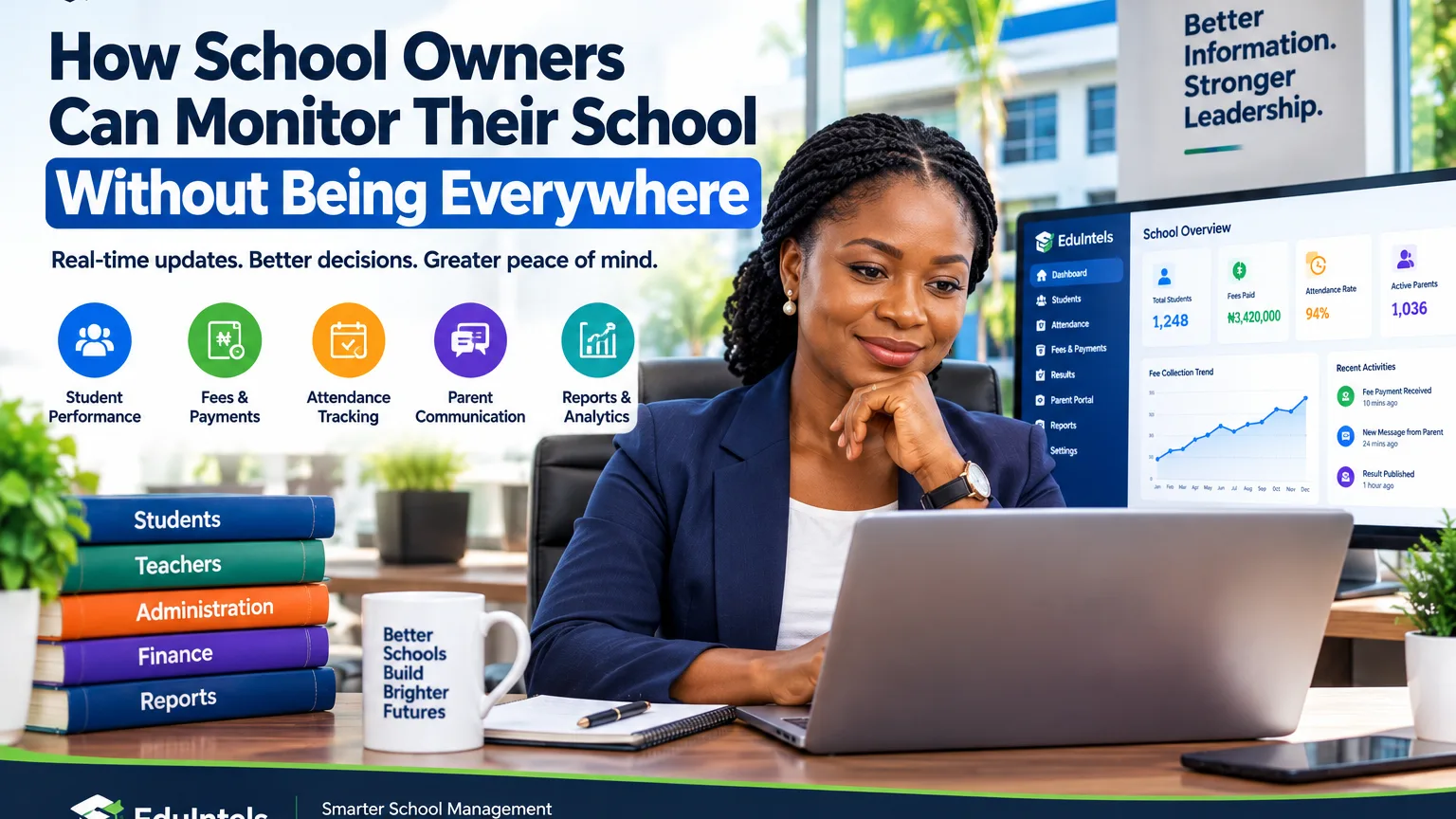
A useful owner dashboard should be selective. Ten reliable indicators are often more valuable than fifty decorative charts. Start with measures tied to cash, students, service quality and operational risk.
Typical examples include active enrolment, new applications, collections today, outstanding invoices, student attendance, staff attendance where relevant, incomplete results, unresolved incidents, parent-service issues and key system-health alerts. Multi-campus schools may add branch comparisons.
The purpose is not to stare at the dashboard all day. It is to notice exceptions. A sharp fall in attendance, unusual payment reversals or a growing queue of pending applications should prompt investigation.
Use trends, not isolated numbers
A figure becomes more useful when it has context. ₦5 million in collections may be excellent or poor depending on the point in the term, enrolment size and previous performance. Ninety per cent attendance may be normal for one period and a warning sign for another.
School owners should therefore look at trends: collections by day or week, outstanding balances by class, applications moving through the funnel, attendance over time, result-completion rates and enrolment changes across sessions. Trends reduce the temptation to overreact to one unusual day.
A good management system should make comparison easier so that leadership attention goes to meaningful movement rather than random noise.
Build exception reporting into daily routines
The owner does not need a message every time something normal happens. The system becomes powerful when it highlights what requires attention: failed login attempts, unresolved incidents, unassigned records, overdue invoices, incomplete result submissions, pending admissions or other operational exceptions.
This is similar to a hospital monitor or aircraft instrument panel. Normal conditions remain visible, but alerts draw attention to deviation. The school owner can then ask the responsible manager for an explanation instead of searching manually for problems.
Exception reporting also protects time. It allows leadership to remain informed while preserving focus for strategy, partnerships, growth and quality improvement.
Audit trails strengthen accountability
When records change, leadership should be able to know what happened. Who updated a user? Who approved a transaction? When was a result published? Which account attempted to log in? Not every action needs a dramatic investigation, but history creates discipline.
Auditability is especially useful when several administrators work in the same system. It reduces blame based on memory and gives management a factual sequence when resolving disputes. It can also expose training problems when the same type of mistake occurs repeatedly.
A school with strong audit trails does not assume staff are untrustworthy. It recognises that good systems make trustworthy work easier to verify.
Remote visibility should not become micromanagement
A dashboard can tempt an owner to intervene constantly. That defeats the purpose. If every small variation produces a phone call from the proprietor, managers learn to hide information or wait for instructions instead of exercising judgement.
Set thresholds. Decide which indicators require immediate escalation, which belong in a daily summary and which should be reviewed weekly or termly. Give managers room to correct routine issues within policy.
The healthiest use of technology is to increase institutional trust through transparency, not replace leadership with constant monitoring.
Multi-campus schools need comparable data
Once a school operates multiple campuses, verbal oversight becomes especially weak. Each branch may describe performance differently, use different spreadsheets or define terms inconsistently. Headquarters receives reports that are difficult to compare.
A shared platform can standardise core records while preserving appropriate branch-level separation. Leadership can compare enrolment, collections, staffing and other measures on a common basis. This helps identify both problems and practices worth replicating.
The owner can then manage the group as one institution with several operating units instead of several unrelated schools using the same brand.
Create a weekly owner review rhythm
Technology becomes valuable when tied to a management habit. Set a weekly review of a small dashboard and a monthly deeper operational review. Ask the same questions consistently: what changed, why did it change, what requires action, who owns the action and when will it be reviewed?
This turns data into management. Without the review rhythm, dashboards can become decorative. With it, trends accumulate into institutional learning. Owners begin to recognise recurring patterns before they become crises.
The review should also include positive signals. Improved collections, stronger attendance or faster admissions processing can reveal where teams and processes are working well.
How EduIntels supports management visibility
EduIntels already brings operational information into a central administration environment, including school-level metrics, live analytics, finance indicators, students, staff, classes, security activity and system-health information. The aim is to help authorised leaders see the institution as a connected system.
For a school owner, the best demonstration is to ask for the owner journey rather than the administrator journey. What can you see in five minutes? Which issues require opening another module? How are schools or branches selected? What reports can be exported? Which indicators refresh from live operations?
If the platform can reduce your dependence on phone calls, manually prepared summaries and physical presence, it gives you something more valuable than convenience: management capacity.
A simple owner-control checklist
At the end of each week, an owner should be able to answer five questions without launching a manual information hunt: Are students and staff properly accounted for? Is fee collection moving as expected? Are admissions and parent-service issues under control? Are academic workflows progressing? Are there any security, system or operational exceptions that require executive action?
If those questions cannot be answered quickly, the problem is rarely a lack of reports. It is usually fragmented records, unclear responsibilities or weak management routines. Fix those foundations first, then refine the dashboard.
The practical test is whether visibility gives you confidence to step away for a day without feeling that the school has become invisible. That is a better measure of management maturity than the number of reports generated.
Build management continuity beyond the proprietor
One of the strongest reasons to improve owner visibility is succession. A school should be understandable not only to the person who founded it but also to a trusted executive, board member or future successor. If operating knowledge exists mainly in the proprietor’s head, continuity is fragile.
Use the platform to make key structures explicit: who has authority, which schools or campuses exist, who belongs to which role, what financial and academic indicators are reviewed, and what exceptions are unresolved. Combine this with written policies and regular management reviews. Over time, the institution becomes easier to govern because information no longer depends on proximity to the founder.
This does not make leadership less personal. It makes the school more durable. The owner can still set vision, protect culture and make major decisions while the operating system provides a stable factual base for everyone responsible for the institution.
Create an owner dashboard that reflects strategy
Your dashboard should reflect what the school is trying to achieve this year. If the priority is enrolment growth, admissions pipeline and retention deserve attention. If cash flow is tight, collection rate, outstanding value and payment ageing matter more. If academic consistency is the focus, result completion and attendance may be more important.
Limit the first screen to the indicators that could change a leadership decision. Secondary detail can remain one click away. This keeps the dashboard useful for busy owners and prevents the interface from becoming a catalogue of every number the system can produce.
Revisit the dashboard each term. Strategic priorities change, and the owner view should evolve with them. A stable data foundation allows the presentation layer to change without rebuilding the underlying records.
What to test in a remote-management demonstration
Ask the vendor to simulate a day when you are away from the school. Can you see collections, admissions, active students, unresolved incidents and other key indicators? Can you switch between campuses if you operate more than one? Can you open the underlying record behind a concerning number?
Next, ask how sensitive actions are controlled. What can a school administrator do without owner approval? Which activities are logged? How are former staff accounts disabled? Can you tell when important data was changed? Remote visibility is only useful when access governance is strong.
Finally, test mobile responsiveness and realistic internet conditions. Owners do not always review the school from a large office monitor. The experience should remain understandable on the devices and connections you actually use.
Define what the owner should see daily, weekly and monthly
Not every metric deserves the same frequency. Daily owner visibility might include collections, urgent incidents, critical system-health alerts and unusual security events. Weekly review may cover admissions, attendance, outstanding invoices and academic workflow completion. Monthly review can examine enrolment movement, staffing, parent-service patterns and branch performance.
This cadence prevents dashboard addiction. Owners can know that the institution is functioning without checking every screen throughout the day. Managers also understand when their performance will be reviewed and can prepare explanations and actions.
Write the review calendar into management practice. A dashboard without a rhythm becomes wallpaper; a dashboard tied to recurring decisions becomes governance infrastructure.
Ask for evidence, not endless reports
Owners often request more reports when they actually need better evidence. A twenty-page monthly document can hide the one number that requires action. Design reports around decisions: what changed, what caused it, what is the risk, what action is proposed and who owns it.
Where a metric is concerning, drill into the underlying records rather than asking staff to create another summary manually. For example, an outstanding-fee figure should allow finance to identify the relevant invoices. An admissions backlog should lead to the actual pending applications.
This reduces reporting labour and creates a healthier management culture. Staff spend less time formatting information for leadership and more time correcting the conditions the information reveals.
Create escalation thresholds before a crisis
Decide in advance which events require the proprietor or board. A failed payment gateway for ten minutes may be an operational issue; a prolonged outage during fee deadlines may require executive attention. One parent complaint may belong to administration; a pattern involving safeguarding or serious reputational risk requires escalation.
The same logic applies to finance and academics. Set thresholds for unusually high arrears, persistent attendance problems, repeated result delays or serious access-control incidents. Thresholds should be reviewed as the school grows.
Predefined escalation reduces emotional management. The owner becomes involved because a condition met an agreed rule, not because whoever shouted loudest reached the proprietor first.
Use visibility to improve delegation
Delegation becomes easier when the owner can see outcomes. Many proprietors hold on to routine approvals because they fear losing control. A good system allows authority to move closer to the work while preserving records, limits and visibility.
Start by delegating a defined process with clear permissions and a measurable result. Review the output through the dashboard or audit trail rather than redoing the task personally. If the process works, widen the delegation. If it fails, diagnose whether the problem was capability, policy or system design.
This is how a school develops managers instead of simply adding employees. Technology does not replace trust; it gives trust a structure.
Decision point for school owners
Owners should remain present in the life of their schools, but presence should be strategic rather than compulsory. A school that functions only when the owner is physically there is difficult to scale, difficult to delegate and difficult to sell or transfer one day.
Build visibility into the system. Define roles, track a small set of indicators, review exceptions and create management rhythms. Then use EduIntels to test whether your school can move from owner-dependent administration to institution-led operations.
|
Next step: Book an EduIntels demonstration and ask the team to model your school’s current workflow before you choose a plan. |
Source Notes
· EduIntels admin console and analytics architecture, September 2026
· General governance, management-control and exception-reporting principles
· Nigeria Data Protection Act 2023 for responsible access to operational data