
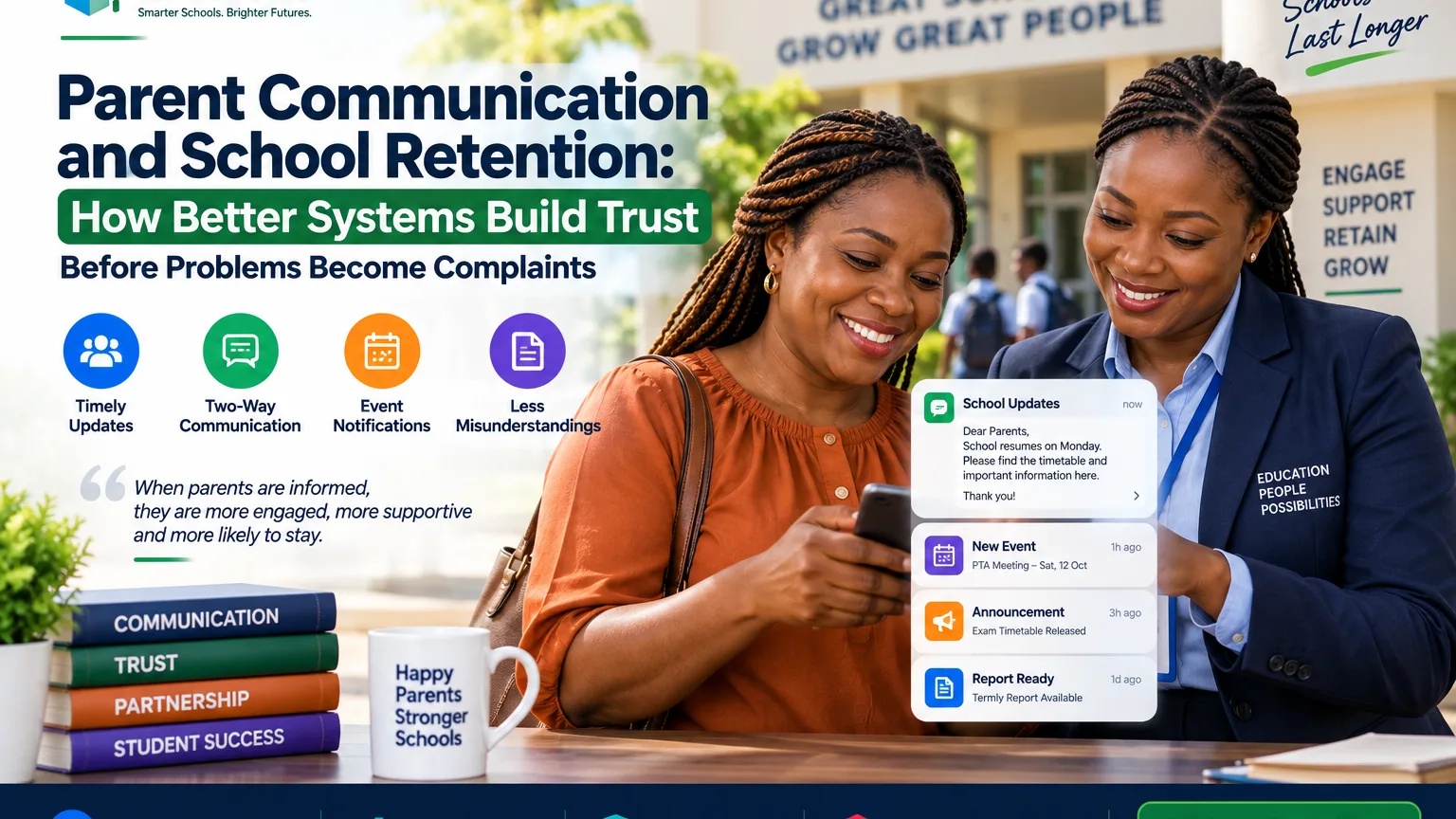
Parents rarely leave a school because of one email. Trust usually changes through accumulated moments: a payment that is not recognised, a result released late, an unanswered complaint, contradictory information from two staff members, or repeated uncertainty about what is happening with a child.
The opposite is also true. Clear invoices, prompt receipts, visible attendance, timely results, consistent announcements and professional follow-up create confidence. These operational experiences do not replace teaching quality, but they shape how families interpret the quality of the institution.
That makes parent communication a retention system, not merely a messaging task.
Parents need consistency more than communication volume
Sending many messages does not necessarily mean a school communicates well. Parents become overwhelmed when announcements arrive through several WhatsApp groups, SMS, printed notes, calls and private chats without a clear source of truth.
Consistency means the same information is available in the appropriate place and changes are communicated deliberately. A fee balance should not differ between the bursar and the parent portal. A result publication date should not vary depending on who answers the phone. An event notice should identify the class, time, venue and required action clearly.
The goal is fewer ambiguous conversations, not simply more notifications.
Build a parent service map around recurring questions
List the questions parents ask most frequently. “How much do I owe?” “Has my payment reflected?” “Was my child in school today?” “When will results be released?” “What is happening next week?” “Who do I contact about this issue?” These questions reveal the service architecture the school needs.
Where possible, let the system answer routine questions directly. This frees staff to handle matters that genuinely require judgement. It also means parents can obtain information outside office hours without waiting for a specific employee.
Self-service is not impersonal when it is designed well. It is respectful of the parent’s time and reduces the frustration of repeating basic requests.
A parent portal should organise the relationship
A useful portal brings together the information a parent legitimately needs about each child. This may include fees and receipts, results, attendance, announcements, schedules and relevant school records. The design should recognise that one parent may have more than one child in the school.
The portal also creates a stable identity for the relationship. Instead of sending sensitive information into informal groups, the school can place personalised records behind authenticated access. That improves privacy and reduces the risk of information reaching the wrong audience.
Parents do not need every internal detail. They need a coherent view of the services and records that concern their family.
Payment communication is one of the fastest ways to build or lose trust
Money is sensitive. If a school sends reminders for an invoice that was already paid, parents may assume the institution is disorganised. If receipts take days to arrive, the parent may wonder whether the transaction was properly recorded. If balances are difficult to explain, disputes become emotional.
A connected finance and parent system can reduce these moments by showing current obligations and recognised payments in the same environment. Clear references and receipts create evidence both sides can use.
Professional fee communication does not mean avoiding difficult conversations. It means entering those conversations with accurate records.
Attendance information can become a trust service
Parents care deeply about whether their children are where they are supposed to be. Attendance systems can support that confidence when records are timely and exceptions are handled thoughtfully.
The school should decide what parents can see and when. Daily visibility may be useful, but schools also need procedures for late marking, authorised absence and corrections. A rushed notification that wrongly says a child is absent can create panic.
The technology should therefore support accuracy first and alerts second. When implemented well, attendance visibility becomes part of the school’s safety and accountability proposition.
Results communication should reduce surprise
End-of-term results should not be the first time a parent learns that a child has been struggling. A stronger system allows the school to maintain orderly assessment records throughout the term and use communication routines to surface concerns earlier.
Even where the platform does not replace teacher-parent conversations, reliable academic records make those conversations more useful. Teachers can discuss actual patterns rather than vague impressions. Leadership can identify classes or subjects where intervention is needed.
The result document remains important, but the deeper value lies in maintaining an accurate learning record over time.
Complaint handling needs ownership and history
Parents become especially frustrated when they must explain the same problem to several people. A complaint may move from class teacher to administrator to finance office without a clear owner. Each handoff increases the risk of delay or contradiction.
Schools should define escalation paths and record important actions. Not every small question needs a formal ticketing system, but significant service issues should have an owner, status and resolution history. This protects both the family and the school.
The lesson is simple: communication quality depends on workflow behind the message. A polite response cannot compensate for an unresolved process.
Use parent data carefully and respectfully
Parent communication systems hold names, contact details, child relationships, financial information and academic records. Access should therefore be restricted to authorised users and data should not be copied into uncontrolled channels without need.
Schools should also keep contact records current. A message sent to an old phone number or email can become a privacy issue as well as a service failure. Provide a clear process for parents to update their details and for the school to verify sensitive relationship changes.
Trust grows when parents see that the school treats information as carefully as it treats money and children.
How EduIntels can support parent experience
EduIntels is designed with parent and guardian access alongside the administrative platform. That allows the school to connect parent-facing information to the same underlying student, finance and academic records used internally, rather than maintaining a separate communication database.
For an owner evaluating the platform, test the parent journey. Create a realistic family with two children. Make a payment, publish information, view attendance or results and check what the parent sees. Then test how staff correct an error and whether the updated information appears appropriately.
If the parent experience reduces repetitive calls, conflicting information and uncertainty, the platform contributes directly to service quality and retention.
Create one official parent information source
Parents should know where the authoritative version of important information lives. If the parent portal shows one balance, a WhatsApp message shows another and a printed note shows a third, trust falls quickly. Decide which system is the source of truth for fees, results, attendance and official notices, then make every other channel point back to it.
This reduces argument and staff workload. It also helps new parents learn the school’s communication habits from the beginning. Informal channels can still support conversation, but they should not compete with the official record.
When information changes, update the authoritative source first. That simple rule keeps communication aligned as the school grows.
Use parent communication as part of the school brand
Every message, receipt, portal screen and response from the school communicates something about the institution. Parents form impressions of order, care and professionalism from these small encounters. That means communication systems should reflect the same standard the school wants classrooms and facilities to represent.
Use clear language, consistent naming and reliable records. Avoid making parents navigate several unrelated channels for basic information. When the school changes a process, explain what is changing, when it begins and where parents should go for support.
A strong parent experience will not compensate for weak teaching, but weak administration can undermine confidence in a strong school. The best brand promise is supported by an operating system that makes everyday interactions dependable.
Turn parent trust into a deliberate retention system
At the beginning of the session, define the moments that most influence parent confidence: admission, first invoice, first payment confirmation, first attendance concern, first academic update, first complaint, result publication and re-enrolment. Review whether each moment has a clear owner and a dependable workflow.
Then connect the moments. A parent who has already provided verified details during admission should not be asked repeatedly for the same information. A recognised payment should flow into the same account the parent sees. A result should be published only after the school’s approval process is complete. Continuity between these moments makes the institution feel organised.
Retention improves when families experience fewer avoidable surprises. Schools cannot control every concern, but they can control whether their information is contradictory, whether issues disappear between departments and whether parents must fight for basic answers. That operational reliability is a competitive advantage in a crowded private-school market.
Build a parent-communication calendar for the term
Plan recurring communication before the term becomes busy. Identify when invoices, reminders, attendance notices, academic updates, event announcements, result publication and re-enrolment messages are expected. Assign an owner to each communication and decide which channel is official.
This prevents the school from communicating only when a crisis occurs. Parents receive predictable information, and staff know what is coming. The calendar also helps leadership review message volume so families are not overwhelmed by multiple departments sending overlapping notices.
After the term, review which messages generated the most questions. Improve the wording, timing or supporting records before the next cycle. Communication becomes a repeatable service process rather than a series of improvisations.
Questions to ask when evaluating a parent portal
Ask how a parent is linked to a child, how multiple children are handled and how relationship changes are verified. Test password recovery, mobile usability and what happens when a parent changes email or phone number. A portal that works only in the ideal case will create support problems quickly.
Test the information parents care about most: current fees, receipts, attendance, results and announcements. Check whether the data comes directly from the school records or has to be re-entered for the portal. The more duplicate maintenance required, the more likely information will conflict.
Finally, examine privacy. A parent should see only the learners they are authorised to see. Sensitive school-administration controls should remain separate. Good parent experience and good access control should reinforce one another.
Measure parent friction, not only parent satisfaction
Satisfaction surveys can be useful, but operational friction is often more actionable. Count how many parents contact the school about missing receipts, unclear balances, forgotten passwords, inaccessible results, timetable confusion or conflicting announcements. These recurring questions show where the service design is failing.
Classify enquiries for one term. You may discover that a large share comes from two or three avoidable causes. Fixing those causes can improve parent experience without launching a major customer-service programme.
The strongest retention work often happens quietly: fewer reasons to complain, faster answers and more confidence that the school’s records are accurate.
Design communication for families with more than one child
A parent with children in different classes experiences the school as one relationship, not several disconnected accounts. Your system should make it easy to see each child while keeping records distinct. Requiring separate logins or duplicating the same parent data creates unnecessary friction.
Communication should also avoid confusion when an announcement applies to only one child or one class. Clear targeting reduces the volume of irrelevant messages and makes important notices easier to notice.
This family-level design is particularly important for retention because multi-child households can represent significant long-term value to a school. Administrative inconvenience should not become a reason for a family to question the relationship.
Create a communication standard for staff
Technology cannot compensate for inconsistent tone and responsibility. Define which channels are used for official announcements, finance matters, academic feedback, emergencies and informal class communication. Staff should know when a personal chat is inappropriate and when a matter must be recorded formally.
Create response expectations for common requests. Not every question requires an immediate answer, but parents should know when to expect one. A simple acknowledgement that an issue has been received can be better than silence while staff investigate.
Consistency protects staff as well as parents. It reduces pressure on teachers to remain available at all hours and directs issues to the roles equipped to solve them.
Connect parent experience to renewal and referral
At re-enrolment time, families remember the whole year. Academic outcomes matter, but so do hundreds of small interactions with the institution. A school that communicates clearly and resolves issues professionally gives parents fewer reasons to reconsider.
Track withdrawal reasons and referral sources. If departing families repeatedly mention administrative frustration, the pattern deserves leadership attention. If satisfied parents generate strong referrals, identify the experiences they value and reinforce them.
Parent experience should therefore sit inside the school’s growth strategy. The most efficient new enrolment may come from a current family confident enough to recommend the school.
Decision point for school owners
Parents do not need a school to communicate every internal detail. They need confidence that when information matters, it will be accurate, timely and easy to find. That confidence is built through systems long before a complaint reaches the proprietor.
Review the ten most common parent questions in your school and ask how many require a phone call today. Then use an EduIntels demonstration to test how many of those questions can be answered reliably through connected records and parent access.
|
Next step: Book an EduIntels demonstration and ask the team to model your school’s current workflow before you choose a plan. |
Source Notes
· EduIntels parent/guardian, finance, attendance and academic workflow architecture, September 2026
· Nigeria Data Protection Act 2023 for personal-data and child-record context
· General customer-retention and service-design principles adapted to private-school operations