If you search for ERP solutions in Nigeria, you will quickly find platforms built for accounting, manufacturing, retail, logistics, healthcare, professional services and many other industries. That is useful, but it can also create confusion for a school owner. A school is an organisation with finance, people and assets, yet it also has academic sessions, terms, classes, subjects, assessments, guardians, attendance, report cards, admissions and safeguarding responsibilities that a generic business ERP may not understand naturally.
The better question is not simply, “Do we need ERP software?” It is, “Which operating processes should one system connect so our school becomes easier to run?” Enterprise resource planning is valuable when it creates one dependable operating environment instead of adding another application to an already fragmented technology stack.
For Nigerian schools, a modern ERP should reduce repeated data entry, improve fee visibility, organise academic workflows, strengthen parent service, control access and give leadership a reliable view of what is happening. The feature list matters, but the connections between the features matter more.
What ERP Solutions in Nigeria should mean for a school
ERP stands for enterprise resource planning. In practice, it means that important organisational resources and processes are coordinated through a shared system. In a school, those resources include students, guardians, staff, classes, money, learning records, facilities, documents, communication and management information.
A school ERP should therefore behave differently from a collection of unrelated modules. When an admitted learner becomes an active student, that identity should be available to class placement, fees, attendance, results and the parent relationship without staff rebuilding the same record repeatedly. When a fee payment is confirmed, the finance record should update the balance and receipt history that authorised users can see. When a student changes class, connected workflows should reference the updated placement rather than maintaining conflicting versions.
This is the core ERP idea: shared records, controlled workflows and consistent reporting. If every department still maintains its own permanent spreadsheet after software is installed, the institution may have digitised individual tasks without creating an enterprise system.
A serious ERP should create one source of operational truth
Many schools already use technology. Admissions may use Google Forms, finance may use Excel, teachers may submit scores through templates, administrators may keep paper files, and parents may receive notices through several WhatsApp groups. Each tool can be useful on its own. The difficulty begins when nobody is certain which record is authoritative.
A modern ERP should give the school a clear answer to basic questions. Which student record is current? Which guardian is linked to the learner? What is the recognised fee balance? Which class is the student in? Has attendance been marked? Which result version is approved? Who changed a sensitive record and when?
The benefit is not that every employee sees everything. The benefit is that authorised users work from the same institutional truth. This reduces reconciliation, prevents duplicate records and makes leadership reporting more credible.
The core school workflows should be connected end to end
Start with the workflows that move through several departments. Admissions is one example. A strong process can take an enquiry or application through review, assessment, decision, acceptance, onboarding and student placement. Finance is another. A fee structure can lead to an invoice, payment, receipt, outstanding balance and management report.
Academic operations require the same thinking. Classes, subjects, teacher assignments, attendance, assessments, scores, approvals and report publication should form a controlled chain. Parent communication should draw from the same student and finance records rather than asking staff to rewrite information into a separate contact database.
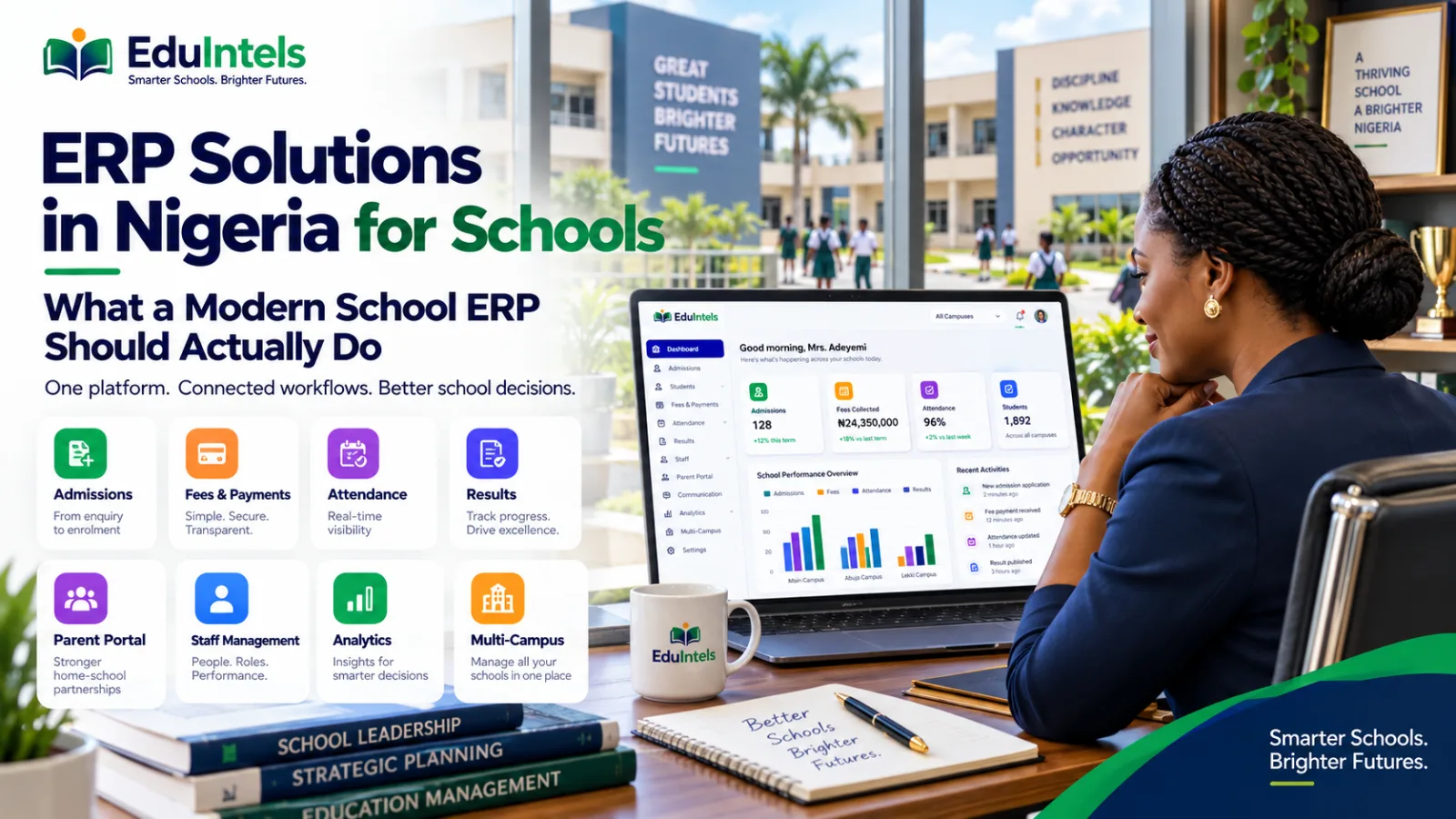
EduIntels is designed around this connected-school approach. Its public platform architecture covers admissions, student administration, staff management, roles and permissions, classrooms, attendance, timetable, messaging, events, library, transport, health records, documents, analytics and integrations, with broader operational capabilities available according to configuration. The practical buying test is not the number of labels in the module directory. It is whether the workflows your school actually depends on can move cleanly from one stage to the next.
Finance must connect billing, payment evidence and management visibility
For many private schools, the financial workflow is the fastest place to see whether an ERP is truly integrated. An invoice is only the beginning. The system should support the way the school charges fees, recognises part payments, handles discounts or approved concessions, records receipts, tracks outstanding balances and preserves an audit history for corrections.
School owners should also separate payment collection from payment visibility. A payment gateway may make it easy for a parent to pay, but management still needs a reliable ledger and reconciliation process. The school should be able to know what was billed, what was collected, what remains open and where exceptions require attention.
When finance connects to the student record and parent experience, fewer questions depend on somebody searching bank statements or chat messages. That is a practical example of ERP value: the same transaction supports accounting, parent service and leadership reporting.
Academic ERP is about workflow discipline, not only report cards
Schools often judge academic software by the final report-card design. The more important question is how the report was produced. A credible ERP should support the structures behind the document: academic sessions, terms, classes, subjects, teacher assignments, assessment events, scores, review stages, result versions and publication controls.
This matters because the cost of a weak result process usually appears at the end of the term. Teachers submit different files, administrators merge spreadsheets, corrections are difficult to trace and leadership has limited visibility into what remains incomplete. A connected academic workflow reduces the number of handoffs and gives the school a clearer completion path.
The same principle applies to attendance and learning records. Data should be captured close to the activity, reviewed where necessary and reused for reporting instead of being recreated later.
Role-based access is part of the ERP architecture, not an optional security add-on
A school ERP contains information about children, parents, employees, payments and academic performance. That makes access design essential. A teacher does not need unrestricted finance access. A bursar does not need to edit academic records. Parents should see only the learners legitimately linked to them. School administrators and platform-level operators should have clearly separated responsibilities.
Ask vendors to demonstrate permissions rather than merely saying the platform has them. Create a teacher account, a finance account, a school administrator and a parent account. Check what each user can see and change. Then ask how former staff are disabled, how sensitive changes are logged and how the system handles school-to-school separation where several institutions use the same platform.
Nigeria also has data-protection obligations under the Nigeria Data Protection Act 2023. Software does not make a school compliant automatically, but a well-designed ERP should support responsible access, retention, security and audit practices.
Nigeria-ready ERP should reflect local operating realities
International ERP platforms can be powerful, but a Nigerian school should test how well a product fits local working patterns. Academic calendars are term-based. Fee structures often include instalments, arrears, sibling concessions, transport, meals, uniforms or optional items. Parents may pay through several channels. Staff may use mobile devices more frequently than desktop computers. Internet quality can vary by location.
Local fit also includes implementation support. A system may be technically capable but still fail if the vendor cannot help the school clean old records, configure classes and fees, train administrators and respond when staff become stuck. Ask who will support the rollout, what channels are available and what the first thirty to ninety days are expected to look like.
Nigeria-ready should not mean accepting lower standards. It should mean global software disciplines applied to the realities of Nigerian schools.
Modular rollout is often stronger than turning on everything at once
One of the common mistakes in ERP projects is trying to activate every available capability on the first day. The result can be training overload, poor data quality and staff resistance. A better approach is to identify the workflows with the highest operational value and launch them in a controlled sequence.
A school might begin with student records, users, roles and finance, then add attendance, results and parent access. Another school may prioritise admissions and communication because enrolment growth is the immediate need. A larger institution may need procurement, inventory, payroll, facilities or compliance earlier.
The ERP should allow the school to expand without rebuilding its foundational records. This is one reason modular architecture matters. Growth becomes an extension of the operating system rather than another technology replacement project.
Multi-campus schools need governance as well as branch access
Running two or more campuses creates a different management problem. Leadership needs branch-level autonomy for daily work, but it also needs common standards and consolidated visibility. Separate databases or unrelated systems can make comparison difficult and create inconsistent definitions.
A multi-campus ERP should clarify which data belongs to each school or branch, which roles can move between contexts, which policies are shared and which reports leadership can consolidate. The owner should be able to compare enrolment, collections, staffing or other agreed indicators without asking every branch to prepare a separate spreadsheet.
This is not only a reporting benefit. It strengthens governance because the group can standardise how core transactions are recorded while still allowing each campus to operate within its assigned authority.
Integrations and data portability protect the school from unnecessary lock-in
No ERP operates in complete isolation. Schools may need payment gateways, SMS or email services, biometric devices, external learning tools, accounting exports or approved APIs. Ask how the platform connects to external services and who is responsible when an integration fails.
Also ask how your school can export legitimate records. Data portability is important even when you expect to remain with the same provider for years. The institution should be able to retrieve key records in usable formats for audit, analysis, backup, migration or regulatory needs.
A vendor that makes entry easy but exit impossible creates operational dependence. A serious ERP relationship should be built on service value, not artificial captivity.
How to evaluate EduIntels as an ERP solution in Nigeria
EduIntels positions itself as a connected operating platform for Nigerian schools rather than a single-purpose result or fee application. The platform combines school administration, finance, academics, engagement, operational modules, reporting, role-based access and multi-school capability. Its current architecture also includes data structures for areas such as payroll, procurement, inventory, facilities, compliance, quality assurance, learning, transport, library, health, documents and alumni workflows.
The correct way to evaluate that breadth is through your own use cases. Bring five real transactions to the demonstration: a new application, a student placement, a part payment, a teacher entering an assessment and a parent checking information. If you operate multiple campuses, add a branch-level reporting scenario. Ask the team to complete each workflow rather than showing only finished dashboards.
Then score the experience on data re-entry, permission control, number of manual handoffs, reporting quality, support requirements and how easily the system can expand. That test is more useful than comparing marketing feature counts.
Decision point for Nigerian school owners
The strongest ERP solutions in Nigeria will not all look the same because organisations have different needs. For a school, however, the foundation is clear: one reliable student identity, connected finance and academic workflows, appropriate user access, useful reporting, parent-ready service and a platform that can grow with the institution.
If your school currently depends on spreadsheets, paper files, payment screenshots and several unrelated applications, do not begin by asking for the biggest feature list. Map the processes that create the most friction. Then test whether the ERP can connect those processes into one operating model.
That is the point at which ERP becomes more than software. It becomes part of how the school is governed, how staff work, how parents experience the institution and how leaders make decisions.
|
Next step: Book an EduIntels demonstration with five real school workflows and ask the team to run them end to end before you compare plans. |
Source Notes
· EduIntels official platform overview and module directory, September 2026
· EduIntels current platform database architecture supplied for this content package, September 2026
· Nigeria Data Protection Commission / Nigeria Data Protection Act 2023 for data-protection context
· Search-market review of ERP software and school ERP queries in Nigeria, September 2026